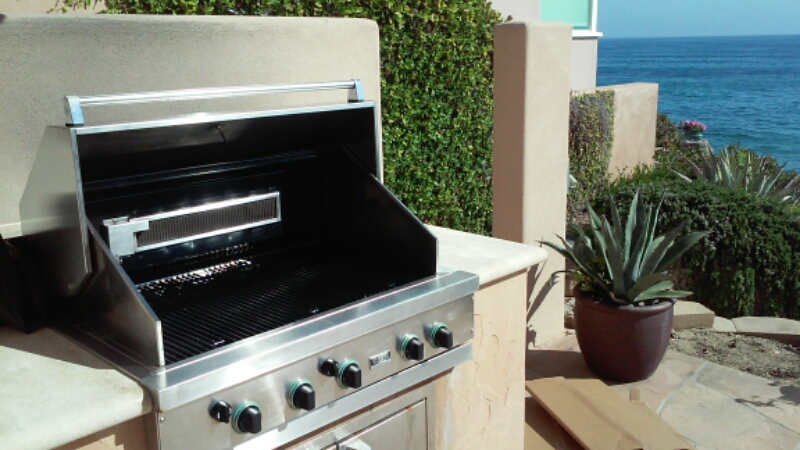

Turbo grills show up in a lot of Orange County backyards, and the Grand Turbo is common in outdoor kitchens where a 40-inch built-in was dropped into a stucco island. When one of them stops lighting, runs uneven or just looks tired, we come to the house with the tools to sort it out on site.
What to know about Turbo grills
since 1980.
The range is easy to recognize. The original Turbo comes in 26 and 32 inch sizes. The Turbo Elite steps up to 32 and 38 inch with extra features. The Grand Turbo is a 40-inch built-in only model. There is also a 32-inch Turbo Charcoal and a Teppanyaki flat-top with two burners.
Construction is the part that matters for repair. The gas models use cast stainless steel burners rated at 12,000 BTU each, double-walled 20-gauge stainless bodies (430 stainless on the original Turbo, 304 on the others), 8mm stainless grates, and ceramic flame tamers that spread the heat. Elite and Grand Turbo add a rear infrared burner for the motorized rotisserie, and the Grand Turbo adds two infrared sear burners. Lighting is blue LED knobs, with halogen interior lights on most models.
Where Turbo grills tend to give trouble
- Igniters that click but never catch, or the Smooth Start ignition built into each valve failing to spark on one burner while the rest light.
- Cast stainless burners with clogged or rusted ports, which show up as yellow flame, popping or one dead stretch along the burner.
- Ceramic flame tamers that have cracked or crumbled under years of grease and heat.
- Rear infrared burners that will not stay lit, which takes the rotisserie out of use.
- Rotisserie motors that stall under a heavy roast or no longer turn.
- Halogen bulbs and LED knob lights that quit, often because of moisture in the socket.
- Surface rust and staining on the thinner 430 stainless found on the original Turbo.
Repairing a Turbo on site
We start by lighting the grill and watching it. Which burners catch, how the flame looks, whether the spark is steady and where the gas pressure sits tell us most of what we need before a single screw comes out. From there we trace the fault: a worn electrode or module, a sticking valve, a regulator or hose problem, or a burner that has simply given out.
Parts that are worn out get swapped, and we light the grill again afterward and let it run so we can see each burner hold a clean blue flame and the infrared burner stay on. On the Elite and Grand Turbo we also run the rotisserie and check the lights. If a part has to be sourced, we finish the job on a return visit. Our BBQ repair service page covers the general process.
Cleaning a Turbo properly
A good cleaning on a Turbo means taking it apart. We pull the grates and flame tamers, lift out the burners, scrape and degrease the firebox and the drip tray, clear the burner ports, and clean the rear infrared burner area where grease likes to collect. Stainless gets degreased and then wiped down with the grain so it looks even, and the knobs and control panel are cleaned and checked while they are off. If you are only after a deep clean, see our BBQ cleaning page.
Restoring a tired Turbo
Cleaning gets a grill back to tidy. Restoration is for a grill that has been neglected or has several worn systems at once. That usually means new burners, fresh igniters, replacement flame tamers, new grates where they have pitted, a working rotisserie and lights, and refinishing the stainless so it looks right again. The goal is a Turbo that lights every time and cooks evenly across the grate. Details are on the BBQ restoration page, and the gallery shows what a finished job looks like.
Built-in and freestanding Turbos
A Grand Turbo is built-in only, so it lives in an island with a masonry or stucco surround, and the access panels and gas connections behind it matter. We work around the island rather than pulling the grill out when we can. Freestanding Turbos on a cart are easier to reach but tend to take more weather and sprinkler overspray at the base.
To keep either style running, brush the grates after each cook, empty the drip tray before it overflows, burn off the grill for a few minutes after cooking with the infrared burners, keep a cover on it, and do not let grease build up around the rear burner. If you are planning a full island, the outdoor kitchens page shows how we work with them.
Turbo service across Orange County
We travel to Anaheim, Fullerton, Orange, Tustin, Costa Mesa, Mission Viejo, Yorba Linda, Garden Grove and Lake Forest, along with the rest of the county, north to south. To get a Turbo on the schedule, use the instant quote form.