
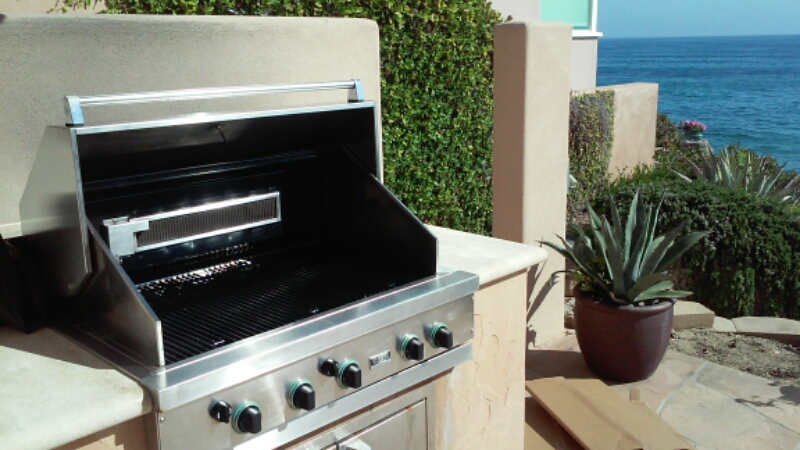

Delta Heat shows up mostly on built-in grills in Orange County outdoor kitchens. These are heavy stainless grills with a clean look and a lot of parts packed into a compact head, and when one begins to act up, it helps to have someone who knows how that head comes apart.
What Delta Heat is, and who builds it
Twin Eagles also sells its own grill line with more configuration options, so the two brands are close relatives. Delta Heat is the more streamlined of the pair, sold in 26, 32 and 38 inch widths, with two burners on the smallest and three on the larger two. There are built-in versions and versions sold on a pedestal cart.
The construction is what you would hope for in a built-in. Inside, stainless U-shaped main burners sit under ceramic briquettes that serve as radiant heat plates, and the RS models swap the U burner for an infrared sear burner. Many versions include a rear infrared burner with a rotisserie kit, plus halogen lights inside the cooking chamber. Ignition is a continuous spark system.
Trouble spots we see on Delta Heat grills
Because the grill has more going on than a basic cart model, the failures cluster around a few components.
- Ceramic briquette trays that crack, glaze over with grease or crumble, leaving hot and cold patches on the grate.
- Stainless U-burners with clogged ports or hairline cracks, which show up as an uneven flame.
- Infrared sear and rear rotisserie burners that will not light or that fire only part of the way across.
- Spark electrodes that are fouled or knocked out of position, so the grill ticks and does not light.
- Halogen bulbs and LED knob lighting that quit, often from heat or a loose connection.
- Rotisserie motors that stall, with bearings and spit rods that need attention.
- Gas valves that get stiff after years of cooking splatter.
Diagnosing and repairing a Delta Heat on site
We look at the flame first, with the hood open and the grill lit, because the pattern points to the cause. A flame that sits weak on one side usually means a burner port problem or a pressure issue, while a flame that lights then dies points more at the valve or thermocouple area. After that we shut off the gas, lift the grates and the briquette tray, and inspect the burners, electrodes, wiring and valve connections. Burners, igniters, briquette trays and bulbs get replaced with parts that suit your model, and we reassemble, then check for gas leaks and light every burner again to confirm the flame, the sear zone and the rotisserie all work as they should.
Because these are usually built into a masonry or framed island, we work from the front and top without pulling the grill out unless there is a real reason to. Our BBQ repair page lays out what the usual jobs involve.
Cleaning a Delta Heat
The welded stainless body is easy to keep looking sharp, but the inside gets the same grease as any other grill. A thorough cleaning means lifting the grates, removing the briquette trays and flipping them, scraping the firebox, clearing the burner ports and cleaning out the drip tray and grease cup. We degrease the interior, wash the hood liner, and polish the stainless along the grain so it does not swirl. Knob bezels and the control panel get detailed with care, since they hold the lighting. More on that is on our BBQ cleaning page.
Restoring an older Delta Heat
If you can see rust at the weld seams, burners that are thin and pitted, briquette trays beyond saving, and a rotisserie that no longer runs, cleaning will not bring the grill back. A restoration rebuilds it: new burners, new heat plates, new igniters and wiring, fresh lighting, and refinished stainless where it is tarnished or stained. The idea is that the grill performs like it did when it was installed. Cleaning fixes dirt, and restoration fixes worn parts.
Built-ins, carts and care
Most Delta Heat grills end up in an island. That cutout needs to give the grill room to breathe, with the right clearances around the sides and the back. A grill that runs in a tight, unvented enclosure will wear its valves and electronics faster. We can look at the island while we are working on the grill, and if you are planning a new build or remodel, see our outdoor kitchens page.
A few habits help. Close the hood after each cook so the grease burns off, empty the drip tray, wipe stainless with a soft cloth along the grain, and cover the grill when it is not in use. If you smell gas, shut it off at the tank or the shutoff valve and have it checked before you use it again.
Serving homes across Orange County
We bring the tools to the house in Anaheim, Yorba Linda, Tustin, Orange, Fullerton, Mission Viejo, Laguna Niguel, Costa Mesa and Lake Forest, along with the neighborhoods between them. Photos of finished grills are in our gallery.